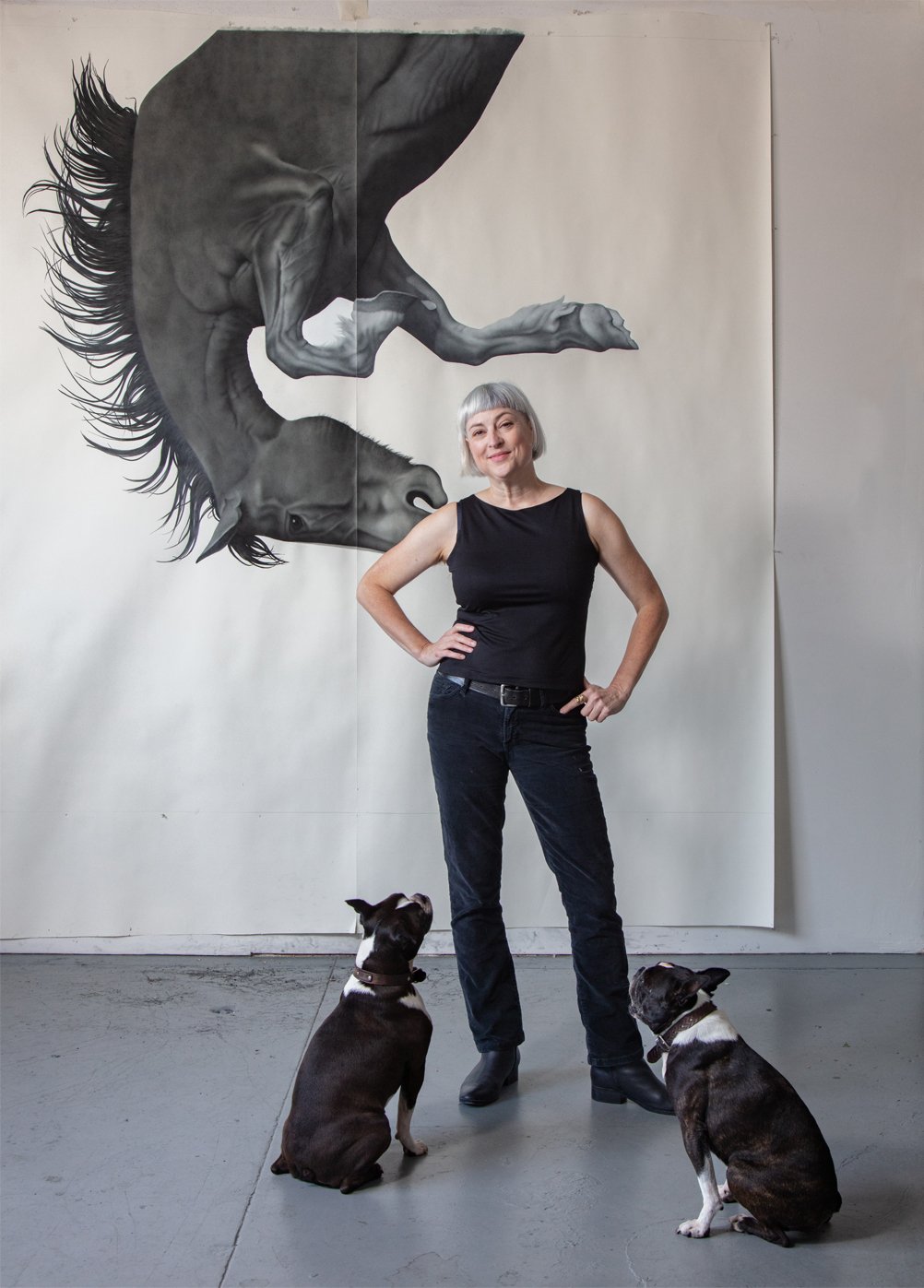
Artist Bio
Larassa Kabel (b. 1970, Mt. Clemens, MI) is a multidisciplinary artist and lifelong Midwesterner. In 1992 she earned a BFA with honors from Iowa State University with an emphasis in fibers; she currently lives in Des Moines, IA where she has had a full time studio practice since 2005. Kabel’s practice frames questions about community, power and value by exercising a fluidity between animals, plants, humans and cultures. American culture’s transience, soul blindness, ecological amnesia and predisposition towards domination instead of cooperation have contributed to a situation that is unsustainable. In response, Kabel’s work creates a world in which we are asked to see ourselves in others and to extend care and empathy beyond our lifetimes. Defying easy categorization, her practice spans drawing, painting, sculpture, photography, performance, and collage. Her work is labor intensive, technically proficient, beautiful and haunting. She often uses objects she finds on her daily walks as inspiration and material for her art.
Kabel’s work has been featured in solo museum exhibitions, numerous curated group shows, public art installations, and book covers. She has received numerous grants and awards, an Iowa Arts Council Fellowship, a fellowship at the nationally renowned Jentel Artist Residency Program, and multiple nominations for the Joan Mitchell and U.S. Artists Fellowships. Her art is held in several permanent collections including the Des Moines Art Center, the Figge Museum of Art, the World Food Prize, and the Sioux City Art Center as well as numerous private and corporate collections. In 2015 Juxtapoz Magazine wrote a feature on her, and her art graced the 2012 White House Christmas card. She was a cofounder of the arts non-profit Chicken Tractor and has created Golden Hind Gallery, a nontraditional gallery in a bathroom that presents national and international shows. She is also an independent curator.
Artist Statement
Growing up in Michigan, I explored the countryside on horseback, falling in love with its beauty and wildness: ducks with their fluffy hatchlings, bucks rutting in the fall, caddis fly larvae in their pebbly jackets, and the interlocking cycles of life and death. I would often bring home bones, feathers and dead birds so that I could draw them. I was more alive out of doors-calmer yet excited by the wonder of it all.
Then, halfway through my senior year, my family moved to Iowa, the most terraformed state in the US. Suddenly wilderness was shrunk down to ditches and the edges of farm fields, and the wild things became sparser and less varied. Even the deer felt farmed, fattened on soy beans and sporting glossy coats and huge racks. There was more roadkill and less unbroken ground. Instead of cooperating with Nature, I saw a dominance over the land and an extraction mentality that felt out of balance and unsustainable. I had a hard time loving Iowa.
Decades later, I’m still in here. I’ve developed a deep relationship with this place despite the monoculture and river pollution. I have become more and more fascinated by our predisposition to view ourselves as outside of Nature when, in truth, we are all part of the same world, each of us as necessary and disposable as every other living thing. Watching the pressures humans continue to put upon Nature has made me even more beguiled by its resourcefulness and drive.
I still collect bones, dead animals and other ephemera for my art (though now it’s done while walking a dog instead of riding a horse). I have used the paper wasp nests built on my 1917 bungalow to create a detailed model of my house. Ghosts, a collection of almost 200 meticulous black gouache paintings of sticks, seeds and grasses, reimagines the cultural hierarchy of humans over plants by applying traditional silhouette portraiture to living things we usually view as a background. Working in a range of media-including drawing, painting, sculpture and performance-I use craftsmanship and hyperrealism to explore ideas about humanity’s relationship to Nature, power, mortality, and biological and cultural legacy.